


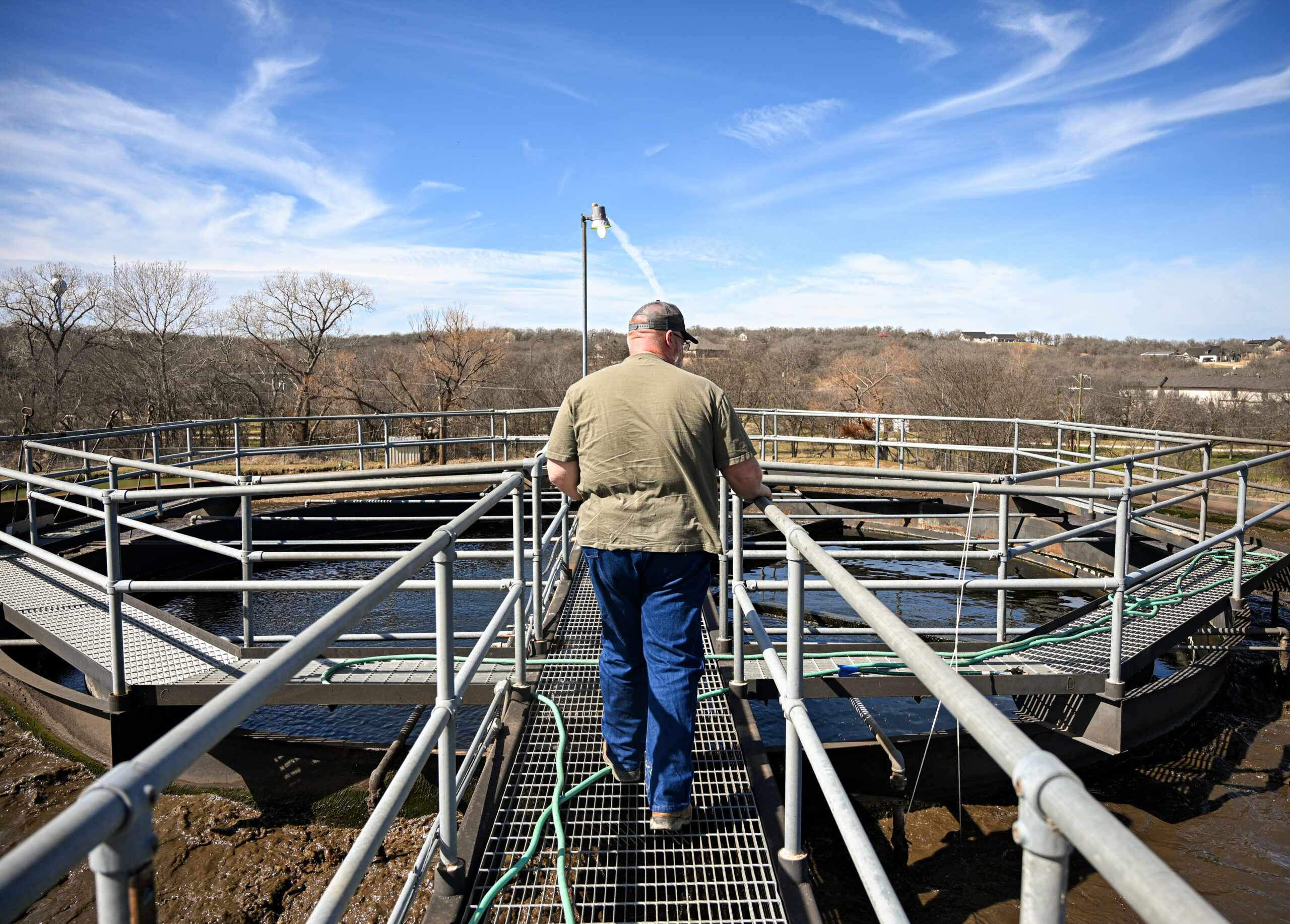
Roddy Boston looks over Runaway Bay’s wastewater treatment plant in February. AUSTIN JACKSON | WCMESSENGER
Rain in Runaway Bay used to be cause for celebration. Now it’s cause for concern.
After heavy rainfall, raw sewage overflows from the city’s wastewater system and into the lake.
It happened again on Feb. 14, aggravating an open wound that has polluted Lake Bridgeport for at least four years as the city waits to begin construction on a permanent fix.
It used to be worse.
“We were dumping 150,000 to 200,000 gallons of raw sewage at a time” White said.
The signs from these spills surface in small ways in the aftermath of a storm: a filtered water jug beside the fountain machine at the One-Stop Gas Station, residents calling city hall about toilet paper on their lawns and ladies not allowing their grandkids to swim.
The stormwater spills happen after the city’s clay sewer lines and brick-and-mortar manholes take on heavy amounts of stormwater, overwhelming the system. The failures force sewage to the surface, eventually flowing toward Lake Bridgeport before it’s treated.
Years ago, White publicly declared the situation a disaster and began lobbying state and federal officials for help. With assistance from U.S. Rep. Ronny Jackson, the city is now positioned to receive approximately $10 million in federal grants for roughly $10.7 million in planned wastewater improvements.
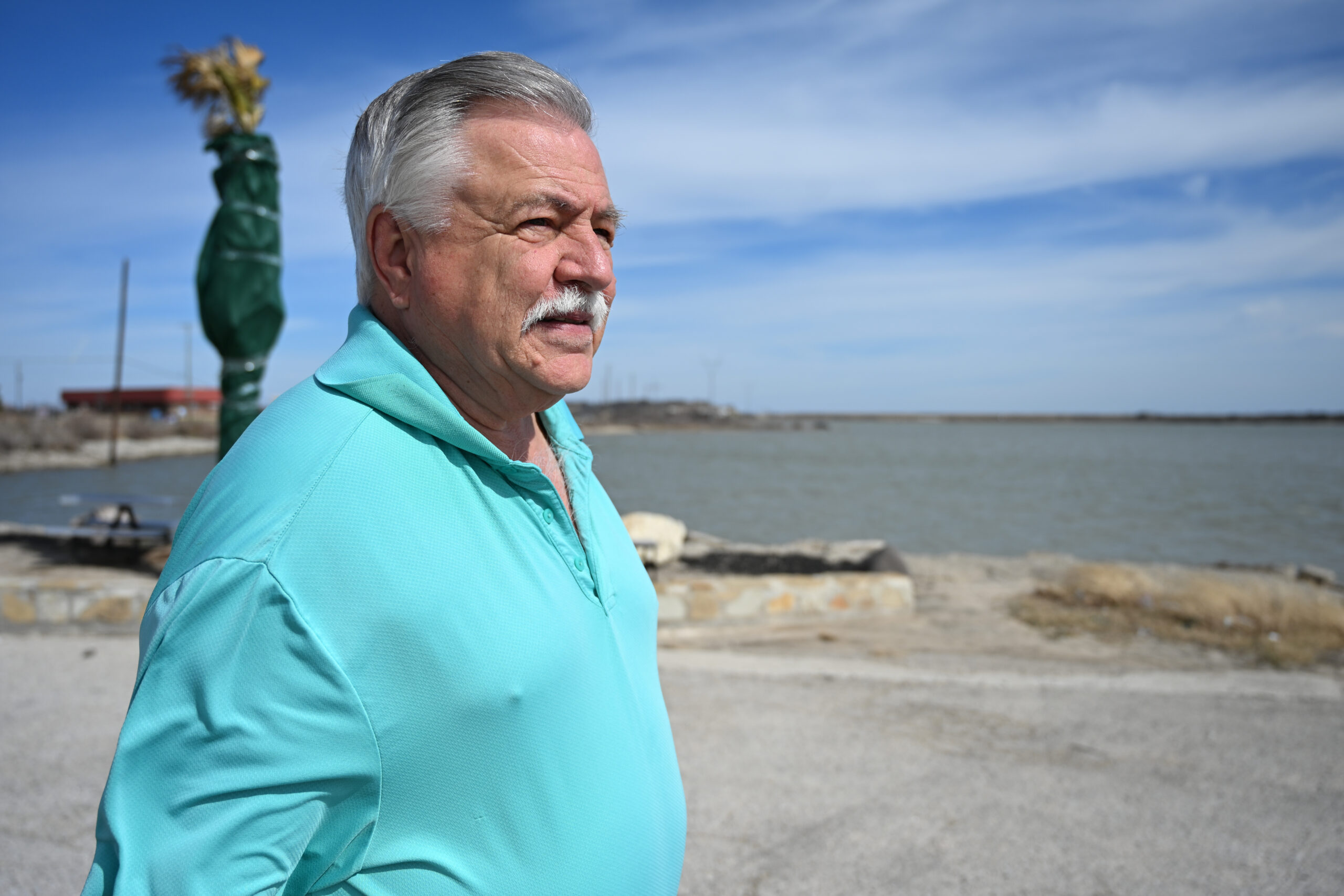
Runaway Bay Mayor Herman White looks out at the lake in the days after a rain event that led to a wastewater spill that reached Lake Bridgeport. The sewer issue is a political lightning rod in the city and in the mayor’s race as White faces a challenge from candidate Sam Berry in the May election. AUSTIN JACKSON | WCMESSENGER
The breakdown, according to the city, is as follows:
EPA State and Tribal Assistance Grant (STAG): $1.75 million appropriated in 2024, $1 million appropriated in January 2026; total EPA STAG funding, $2.75 million.
U.S. Army Corps of Engineers: $6.7 million approved in 2024
City officials said grant applications for both funding streams have been approved. Funds are structured as reimbursement dollars, meaning the city must front project costs and meet federal compliance requirements before receiving payment.
Engineering firm Freese and Nichols is completing design work, with plans expected to be finalized this fall. Once approved, the city will seek bids. Officials said they have already secured a line of credit to cover the costs, which would later be recouped through reimbursements.
Federal dollars and environmental agency approval, however, do not move as quickly as storm water.
A Tuesday after the storm
A few days after the February rainfall, Roddy Boston drove between lift stations in his wife’s pickup that’s lined by Beanie Babies on the dashboard.
The sun was out, and so were crews.
The city’s wastewater consultant fielded updates from city employees who were checking on reports of a spills near homes and updates on the work to solve a problem at the treatment plant.
After parking at the wastewater treatment plant, Boston climbed metal stairs of the basin where cloudy wastewater turns clear, and pointed to a failure point during the storm.
A lift station near the plant had jammed, forcing sewage into a nearby stream that empties into the lake. Crews initially suspected mechanical failure.
“The pump was fine,” Boston said. “It was just packed solid.”
When storm water rushes through aging pipes, it has a flushing effect — essentially causing an avalanche of sewage, sediment, debris and more wet wipes than Boston would care to count to the plant and its lift station.
Last month’s spill was caused because of a backup at that lift station, Boston explained, which overflowed at the plant site and caused several neighborhood manholes to overflow.
While Boston did not yet have a final spill estimate for the February storm that day, he said a heavier rain event in May resulted in the release of roughly 75,000 gallons into the lake. That figure that would have been higher without vacuum trailers and pump trucks intercepting the flow.
For now, containment is the strategy.
Boston, who manages the wastewater treatment facility in Decatur full-time, was brought in as a consultant contractor after the city received a violation from the Texas Commission on Environmental Quality and needed a properly certified operator.
That temporary gig has stretched into the months. Boston said he felt the need to stay until the city’s treatment operations were in order.
“I couldn’t leave,” Boston said.
Resort roots
Runaway Bay was developed as a resort. Now the city sends out about 1,300 utility bills a month.
After the original developer went bankrupt in the 1980s, the city inherited infrastructure that wasn’t designed for a municipality, and over the years, the costs to improve the infrastructure started to fall on an aging, largely retired tax base.
A wastewater study was commissioner years before White took office, he said. But it wasn’t used.
“For whatever reason, it collected dust,” White said.
As development continued and more homes tied into the system, the city kicked the can down the road. In 2016, the Messenger reported on a sewage spills at the Bay Landing campgrounds. After a major spill in 2022, White sounded the alarms, arguing that the city’s sewer problem was a disaster of regional proportions.
That assessment was made because Lake Bridgeport feeds into the West Fork of the Trinity River, which supplies a chain of lakes in North Texas as it winds down to the metroplex.
While water treatment plants can generally adapt and treat water that’s been compromised by raw wastewater spills, it’s still not ideal, and it’s not safe to swim in either.
The EPA notes that exposure to untreated wastewater can cause gastroenteritis. Its symptoms include nausea, vomiting, diarrhea, headache and fever. Swimmers may also experience ear, eye, nose and throat infections. In heavily polluted water, exposure can lead to more serious effects from cyanobacteria, algal blooms that release toxins that can affect the skin, liver and kidneys.
“We don’t have the resources to tackle this ourselves,” White said. “We needed help.”
“It didn’t just affect Runaway Bay,” he added. “We were affecting two counties and millions of people downstream.”
The plan to stop it
When operating normally, the wastewater treatment plant runs well below capacity. It can treat up to 400,000 gallons per day and averages about 100,000.
The failures occur before wastewater reaches the plant.
The city operates 17 lift stations, seven along the lake. Some rely on single pumps. Engineers have identified deteriorating concrete, outdated electrical systems, limited backup power and insufficient pumping capacity throughout the network.
“There isn’t a single silver bullet,” White said. “It’s the pipes. It’s the manholes. It’s the lift stations.”
Planned improvements total about $10.7 million, according to a 2025 facility assessment. Projects include upgrades to all 17 lift stations and targeted treatment plant work.
One of the most urgent projects involves the Jim Walters Lift Station, which operates with a single 40-horsepower pump. Engineers have recommended installing a second pump and rail system, along with structural repairs, coatings, piping and electrical upgrades.
Design work on the Jim Walters and Port O’Call lift stations is advancing. At the treatment plant, short-term improvements, including chlorine building ventilation and generator rehabilitation, are estimated at $1.19 million. A proposed second package plant, estimated at $5.76 million, is considered a long-term expansion.
In a document provided by the city to the Messenger, Jeff Hammon, P.E. of Freese and Nichols issued a status report Feb. 16. He said that the Environmental Protection Agency has confirmed the city is eligible for reimbursement for infiltration and inflow services,
He said the project partnership agreement with the U.S. Army Corps of Engineers is expected to be fully executed as soon as it receives a commander’s signature.
Regarding specific infrastructure, Freese and Nichols submitted the initial 50 percent design drawings and cost estimates for the city’s chlorine building, with the project expected to be bid ready by March 19. Jim Walters and Port O’Call lift stations should be 50 percent designed by March 24 and bid ready by June 18.
White said the city would not have been able to approach the problem without federal assistance.
A substantial rain typically boosts lake levels and tourism in North Texas communities.
In Runaway Bay, it can also raise anxiety for residents and for city staff tasked with limiting lake pollution.
Over the past four years, crews have developed processes to reduce the volume reaching Lake Bridgeport. But until aging infrastructure is replaced and improved, it won’t stop.
White described the crisis as a wake-up call that has pushed the council to adopt a longer-term approach. White pointed out some of the recent successes, like pursuing plans for potential long-term needs and completing upgrades to the water treatment plant and the city’s new water tower.
Amber Thompson, who assists with city communications, said officials are seeking an additional $7 million in federal relief for 2027.
Until construction is complete, residents near lift stations and along the lake will continue watching the forecast.
“I’m 72. I won’t be here forever,” White said. “This is about my grandchildren.”
Loading Comments