



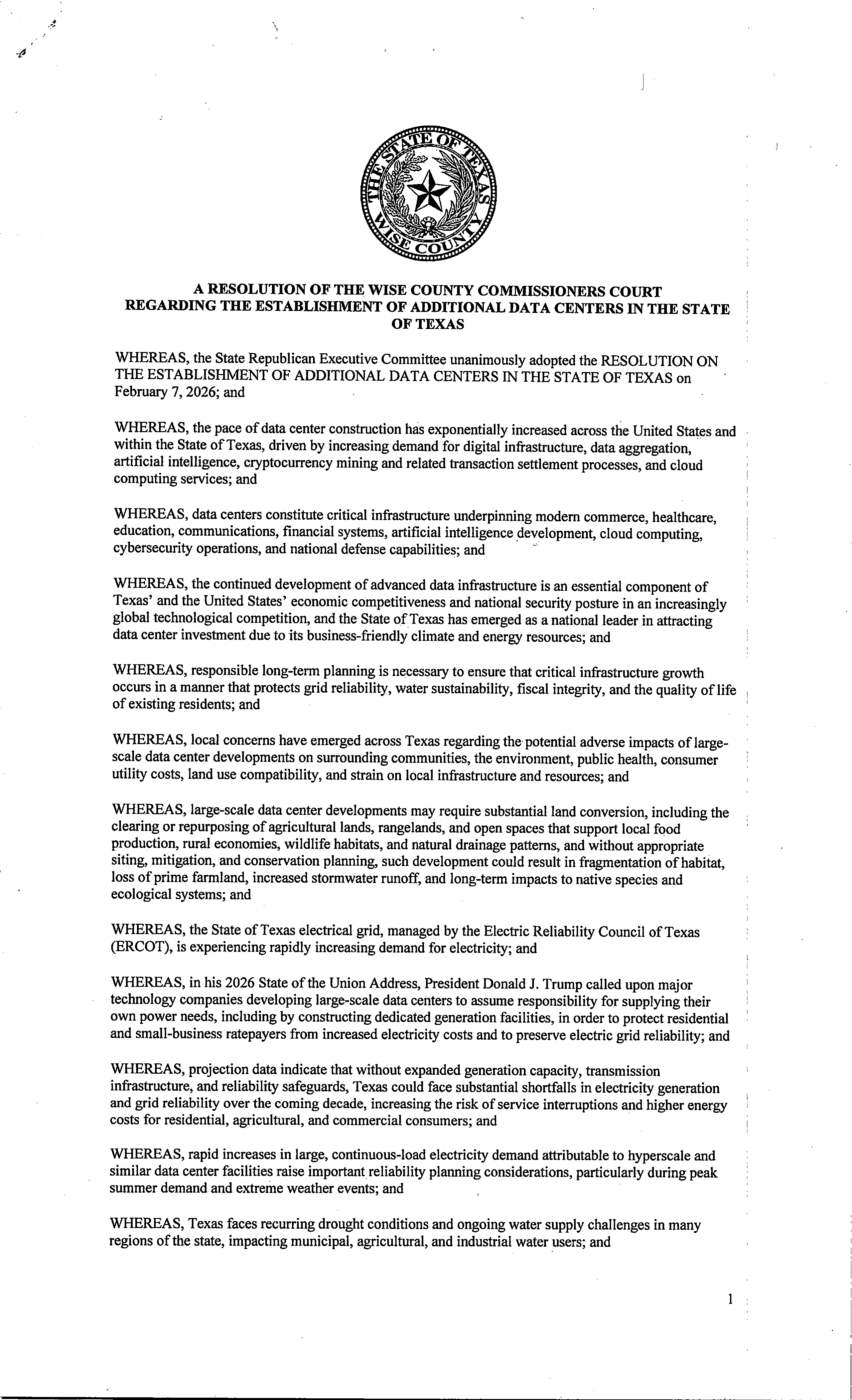
Wise County Commissioners issued a resolution seeking help from the state legislature to help manage the development of data centers in unincorporated areas of the county. Pictured is a data center under construction near Hutto in 2025. steheap – stock.adobe.com
Wise County Commissioners called on state lawmakers to rein in the development of data centers, or give county governments the power to do it themselves, through a county resolution unanimously approved by the court after a public hearing Monday.
The resolution — which comes as Jack County grapples with a data center proposed near the Wise County line — presses legislators to call a special session and consider changes that would provide safeguards on the development of large-scale data centers, addressing concerns officials say are being felt across Texas.
Around 90 people attended the meeting at the Wise County Law Enforcement Center. A separate hearing on the county’s master thoroughfare plan update was also held Monday, adding to the draw from the hot-button data center issue that is creating both problems and an economic boom in Texas.

Around 90 people attended Monday’s Wise County Commissioners Court meeting in the JP Courtroom of the Wise County Law Enforcement Center. AUSTIN JACKSON | WCMESSENGER
Data centers are essentially massive facilities that house the digital infrastructure required to process the growing demand for data aggregation, artificial intelligence, cryptocurrency mining and cloud computing services. Data center campus buildings are often hundreds of yards long. The primary concerns surrounding these large industrial projects are the amounts of water and electricity needed to operate them.
Counties in Texas have no authority to regulate what types of businesses can be built in unincorporated areas, unless it’s a sexually oriented business, like a strip club.
The narrow scope of county land-use authority is geared towards residential development. The commissioners court becomes involved when a sect of land is subdivided into lots, triggering groundwater availability studies (a statutory authority allowed by the state legislature in 2024), traffic impact analysis, and the enforcement of drainage requirements and entrances that provide adequate access for first responders.
But what can the county do when a developer doesn’t subdivide — when a corporation purchases hundreds of acres and uses that entire property for something big, like a sprawling data center campus?
“Nothing,” Wise County Judge J.D. Clark explained. “They could start building tomorrow and they wouldn’t even have to tell us.”
He described data centers and their expansion in rural Texas as a unique issue — one that demands a closer look at local regulatory tools. The only way the county would have to be brought to the table, he said, would come from the developer seeking a property tax rate break.
The resolution was sent to the offices of Governor Greg Abbott; Lieutenant Gov. Dan Patrick; Texas State Senator Tan Parker; Texas State Representative Andy Hopper; The Public Utility Commission of Texas; The Electric Reliability Council of Texas; The Texas Water Development Board; and other regional and local governmental bodies.
Several residents spoke during public comment urging commissioners to prevent data centers from straining local resources already affected by the growth that has pushed the county’s population to around 85,000 residents.
Clark described the resolution as a proactive measure. He hopes other counties pass similar resolutions and it encourages state action, and possibly, warns off data center suitors from selecting Wise County as an expansion site.
He encouraged public comment participants, who led their statements by asking commissioners to do something, to help give them the ability to do so.
“I hear that you have limited ability, and I’m ignorant on the topic, other than I know when I ask Google something, it takes about a liter of water, which is a lot for every time we Google something,” resident Debbie Steele said during public comment. “How can I help fight for what you need to be able to take care of this?”
“Should we adopt the resolution, I would write an email to everybody on this transmittal form, and let them know my county passed this resolution, urging them to take action,” Clark answered. “Either the state’s got to help us, or they need to let us make local decisions on how this will work.”
The Texas Legislature will convene for its 90th session Jan. 1, 2027.
Wise County Data Center Resolution


The public comment portion of the hearing operated as an open dialogue, with questions about county authority and data center impacts. Republican Pct. 19 Chair Brenda Platt asked whether the court could ban the construction of mosques in the unincorporated areas of Wise County. (They cannot.) Parker County resident Jim Harvinson praised Wise County for actively attempting to address the issue, before the arrival of data centers in the county.
For the most part, residents shared water and electricity concerns. Carrie Baran questioned whether the closed-loop water usage for the proposed Jack County data center, described as a one-time fill-up of 200,000 gallons, was accurate. She said leaks and maintenance issues would require refills to repressurize lines to bring the center back online.
Others shared concerns about drainage issues caused by replacing expanses of brush, grass and trees with acres of concrete. Another asked if the county has considered the potential impact on groundwater recharge from the development of properties of this scale, and what these data companies plan to do with these massive structures whenever they are decommissioned or are no longer operating.
Pct. 4 Commissioner Colby Shawn said micro nuclear reactors are an example of an alternative energy advancement that could take some pressure off the ERCOT grid, but those have yet to be used for this application. He also explained that their usage, once approved, may only be suitable for backup power.
Clark and Shawn, who spent several days in Washington last month to learn more about the data center landscape, each reiterated their frustration with the lack of tools at their disposal to meet the wishes of the community.
“We need help on this. Between private property rights and doing what’s best for the community, it’s a constant balancing act,” Clark said. “You don’t want the county government or the city government to have undue authority over private property, but with things that are impacting the entire community, at what point do the counties have some tools to help reflect what their community wants?”
“We don’t have that ability right now,” Clark added. “We’re located in a priority groundwater management area, and I think we and other counties in our position should get special considerations on these industrial developments.”
Some highlights of the resolution include the county’s opposition to any data center on an open-loop cooling system “or other high-volume potable water consumption technologies in large-scale, high continuous-load data center facilities within water-constrained regions, absent demonstrated sustainable supply and mitigation safeguards.”
It also calls for mandatory public reporting of projected electricity and water use for proposed data centers and independent impact studies evaluating grid reliability, water availability, environmental effects and potential costs to local taxpayers.
County officials maintain that they have not been approached about a data center project within Wise County, but the major development proposed just across the county line in Jack County, would impact Wise County, potentially creating jobs as well as additional traffic on area roads.
As Clark mentioned, one could be pressing forward, and the county government wouldn’t necessarily be notified, unless they were seeking a property tax abatement. The county judge also said that a third-party would represent the county if ever contacted by a developer for an abatement. But that hasn’t occurred so far. He also explained that the county has never executed an abatement before.
The data center that drew attention on the issue locally, proposed near the Wise-Jack line, is located off Texas 199 near County Road 3940 and East Gibtown Road. The 453-acre property is registered under NCA Holdings.
According to the Jacksboro Herald-Gazette, the project is being undertaken by C1 Jack I LLC, also known as CyrusOne, a Dallas-based data center developer. Construction could begin as early as this year. The paper reported that each data center on the campus would use a closed-loop cooling system holding about 200,000 gallons of water with a one-time fill up of trucked in water.
It will reportedly have capacity to power at least 144 megawatts, drawing power from the Wise County Power Station, the natural gas plant located across from the proposed data center campus.
The project could be worth as much as $2 billion at full build-out and would represent a major expansion of the local property tax base.
Jack County commissioners have been considering a partial tax abatement for the project. While the abatement has drawn criticism, Clark argued it’s currently the only way for county governments to have any say on the project and provide leverage to mitigate potential impacts on natural resources and existing infrastructure.
If data centers aren’t shipping in water, and wanted to draw from the groundwater supply, they would be required to obtain a permit to drill a well and prove adequate supply through the Upper Trinity Groundwater Conservation District. In other cases, a developer could also purchase an allocation from an existing surface water source, but that agreement would also not come before the county, Shawn explained.
Since the meeting, a group of Wise County residents have organized a letter-writing campaign to lawmakers.
One resident posted that members of the Jack/Wise County Data Center Discussion Facebook Group booked a room at the Bridgeport Public Library from 2-3 p.m. March 16, inviting the community to write letters and donate stamps and other materials.
Jack County Commissioners also met Monday. The agenda did not list action on the proposed data center or the abatement application.

Jack County Commissioners Court March 9 agenda
Loading Comments